
Is a Hans Wegner Papa Bear chair replica worth it?
A Hans Wegner Papa Bear chair replica is worth it when you want the enveloping wingback shape for daily use, have a set budget, and check the frame and upholstery before you pay. It is not worth it if the maker's name and provenance matter to you.
- A Hans Wegner Papa Bear chair replica is worth it for buyers who want the shape and daily comfort, not the provenance.
- Skip the replica if you want the original maker's name, a collector's piece or resale value.
- Judge any replica on frame, upholstery, proportions, seat comfort and returns terms, not on photos alone.
- Measure your room first: the Papa Bear's wide arms and deep wings need more floor space than they look like they do.
Why this matters
The Papa Bear is one of the most recognisable armchairs in Danish design, and it is one of the most copied. Quality across those copies is uneven. Two chairs can look identical in a product photo and feel completely different after a month of use.
So the useful question is not whether a replica is acceptable in principle. It is which replica is worth your money, and for which kind of buyer. That is what this page settles.
Is a Hans Wegner Papa Bear chair replica worth it?
Yes, for buyers who want the look and the sit of the chair at a lower cost than the original. No, for buyers who want the original. A well-made replica gives you the sweeping arms, the high enclosing back and the deep seat. It does not give you the original maker's name, its documentation or its place in the collector market.
The quotable version: a Papa Bear replica is best for people furnishing a real home who value form and comfort over provenance, and a poor choice for collectors.
Here is how the two compare on the points that matter.
| Point | Replica | Original |
|---|---|---|
| Shape and silhouette | Can match closely when well made | The reference design |
| Upfront cost | Lower | Much higher |
| Provenance and maker's name | None | Yes |
| Resale or collector value | Low | Strong |
| Build quality | Varies widely by seller | Consistently high |
| Best for | Daily use in a lived-in home | Collectors and long-term investors |
The pattern is simple. You trade provenance for access. Whether that trade is good depends on what you wanted the chair for in the first place.
When a replica is worth it
A replica makes sense in these situations:
- You want to sit in it, not store it. If the chair will be your reading seat or the anchor of a living room, shape and comfort matter more than a maker's name.
- You are furnishing several rooms. Spending the budget on one original can leave the rest of the home bare. A replica lets the money stretch across the room.
- You are building a mid-century modern scheme. The Papa Bear sits well beside Danish-style sideboards, slim-legged tables and warm timber. Mobelaris sells mid-century modern furniture and lighting that suits that scheme.
- You rent or move often. A chair you can replace without heartbreak is a lower-stress purchase.
Verdict: Buy, if you check the details below.
When to skip the replica
A replica is the wrong call in a few cases:
- You care about provenance. A replica is not the original and will never be treated as one. If that bothers you, you will resent it.
- You expect resale value. Original designer chairs hold value. Replicas generally do not.
- You cannot inspect or return it. A chair bought unseen, from a seller with unclear returns terms, is a gamble on every point in the checklist below.
- You are chasing the cheapest option. The cheapest copies are where proportions, padding and joinery go wrong first.
Verdict: Skip, if provenance or resale value is the point.
What to check before you buy
Five checks separate a good replica from a disappointing one.
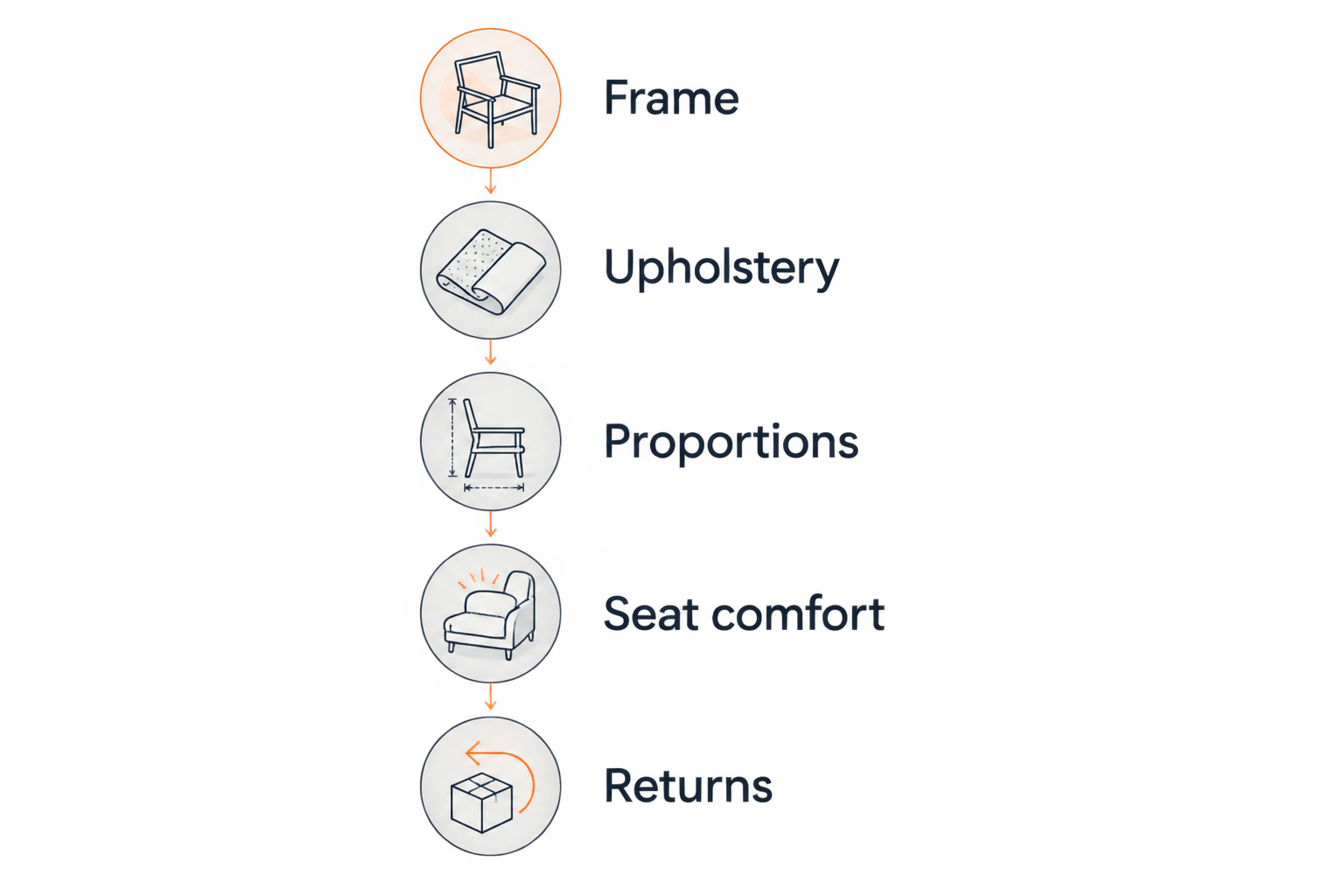
- Frame. Ask what the frame is made from and how the joints are built. A sellers who cannot say is a warning in itself. Look for clear descriptions of the timber and construction rather than vague wording.
- Upholstery. Read the material description closely. Leather and fabric behave differently over time, and the listing should say which one you are buying and how it is finished.
- Proportions. The Papa Bear's character comes from its sweeping arms, high back and deep seat. If photographs show a narrow back, stubby arms or a shallow seat, the shape is off and no amount of styling will fix it.
- Seat comfort. Look for descriptions of the seat and back cushioning. A chair meant for long sitting should say how it is padded, not only how it looks.
- Returns. Check the seller's returns terms before ordering. A chair this large is hard to judge from a screen.
For a longer walk-through of the same ideas, the guide on how to spot a high-quality furniture replica online goes through listings line by line.
Why replica quality varies
The same chair name can cover very different products. These are the factors that drive the gap:
- Frame construction. Timber choice and joinery decide how the chair ages.
- Padding and support. Soft-looking seats can sag early if the support underneath is thin.
- Upholstery material and stitching. Seams and finishing show quality quickly, especially along the arms.
- Fidelity to the original proportions. Cheaper copies simplify the curves.
- Seller transparency. Good sellers describe materials and construction. Weak ones rely on photos and adjectives.
None of this requires technical knowledge. It requires reading the listing as carefully as you would read a contract. The wider question of how far a copy can go is covered in whether replica furniture can match the quality of the original.
Leather or fabric for a Papa Bear replica?
Both work, and the choice is about how you live. Leather suits a clean, structured mid-century look and tends to develop character with use. Fabric softens the chair and suits a warmer, more relaxed room.
Whichever you pick, confirm the exact material in the listing. "Leather-look" and genuine leather are different products, and the description should make clear which one you are getting.
Will it fit your room?
The Papa Bear is a large, sculptural chair. Its wings and arms take up more visual space than the seat suggests, and it needs breathing room on all sides to look right rather than crammed.
Measure the corner or wall where it will sit, and compare against the dimensions in the listing, not against a photo. Leave space to walk around it and to place a side table within reach.
It also helps to know how the chair behaves, not only how it looks. Wingback shapes are built for upright, enclosed sitting, and whether Danish wingback chairs recline is worth settling before you buy any chair in this family, because a fixed frame suits a reading seat and not a lounger.
FAQ
Is a Papa Bear chair replica worth buying?
A Papa Bear chair replica is worth buying if you want the shape and daily comfort without paying for the original maker's name. It is not worth it if provenance or resale value matters to you.
How can I tell a good Papa Bear replica from a poor one?
Check the frame description, the upholstery material, the proportions in photographs, the seat padding and the returns terms. A seller who explains construction clearly is usually a safer bet than one who only shows photos.
Does a replica hold its value like the original?
No. Original designer chairs are collected and resold, while replicas generally are not. Buy a replica to use, not to invest.
Is leather or fabric better for a Papa Bear replica?
Neither is better outright. Leather suits a structured mid-century look, and fabric gives a softer, warmer feel. Confirm the exact material in the listing before you order.
What size room does a Papa Bear replica need?
It needs a room with space around it, because the wide arms and high wings take up more room than the seat suggests. Measure your space and compare it with the listing dimensions.
Where can I read more about this specific chair?
Mobelaris covers the chair in a dedicated guide on what to know about a Hans Wegner Papa Bear chair replica, linked in the related guides below.
One last thing
The best test of a replica is also the simplest: would you still want this chair if nobody ever asked what it was? If the answer is yes, because you like the shape, the sit and the way it fills the corner, then the replica is worth it. If the answer is no, because the name is the point, save for the original.