
Replica furniture for property developers: complete guide
Property developers’ replica furniture sourcing is the selection of reproduction-style furniture with the aim of presenting a coherent residential interior and keeping purchasing aligned with the project brief. This guide covers show homes, furnished homes and phased developments, where you need to distinguish what appears in marketing from what stays at handover.
- Replica furniture for property developers starts with a room schedule, not a list of recognisable designs.
- Mobelaris suits developers seeking mid-century modern furniture and lighting for residential interiors.
- Keep show-home styling, furnished-home purchasing and handover inventories separate.
- Approve exact product selections before repeating a furniture scheme across different layouts.
Why replica furniture matters for property developers
Treat furniture as part of the property brief, not a finishing purchase. A show home needs to explain the layout. A furnished home needs an agreed contents list. A phased development needs a record of what was selected and where it belongs.
These are different decisions. A chair chosen for a photography composition is not automatically the right selection for every completed home, and a room photographed with accessories does not explain which items are included in a purchase.
Start your shortlist with the principles in the guide to assessing furniture replicas online. Then assess each candidate against your own room brief rather than treating a familiar silhouette as sufficient evidence.
Replica furniture does not establish a sales outcome or a product’s suitability by itself. The useful question is narrower: does the exact item support the interior you are specifying, and can your team record the selection clearly enough to purchase and hand it over without ambiguity?
How to plan your furniture scheme
Define the brief
Write the brief in a shared document before browsing. State whether you are furnishing a marketing space, preparing a home with included contents, or developing a repeatable scheme for several properties. Give each purpose its own purchasing list.
Describe the intended interior in practical language. Mid-century modern, restrained and warm is a clearer direction than a collection of unrelated designer references. Identify which architectural finishes are fixed so furniture selection responds to the property rather than starting a competing scheme.
Make the inclusion boundary explicit. Your sales team, stylist and purchasing lead should work from the same distinction between presentation items and included furniture. A beautiful room is not an adequate inventory.
Best for: developers establishing a scheme before individual products are selected. The limitation is that a written brief still needs a room-by-room check; it does not resolve layout differences.
- Name the purpose of each furnished space.
- Describe the intended style without prescribing unsupported specifications.
- Record existing floor, wall and kitchen finishes.
- Separate presentation items from included contents.
- Assign a person to approve changes.
Map each room
Use the floor plan and a simple spreadsheet to give every room its own furniture schedule. Record the furniture role first: main seating, occasional seating, dining furniture, storage or lighting. Add product candidates only after the role is clear.
Review each layout independently. A scheme approved for a larger living room should not become the default for a smaller room simply because both properties share the same finish palette. Keep the visual relationship between pieces consistent without assuming the complete arrangement transfers unchanged.
Mark where furniture belongs on the plan. This is a composition exercise, not an installation guide: you are showing how the room reads and which functions the furniture is intended to support. Keep measurements in metric units when recording your project information.
Best for: developments with different room arrangements. The trade-off is more planning work at the start, but the schedule makes layout-specific decisions visible rather than hiding them in a generic shopping list.
- Give each room a clear name or reference.
- List furniture roles before product names.
- Match each schedule to its corresponding floor plan.
- Note which selections repeat across layouts.
- Record exceptions beside the affected room.
Build the shortlist
Begin with a manual mood board containing the room finishes and candidate furniture photographs. Compare the whole composition, not isolated product images. A striking piece should earn its place through its relationship with the room.
Mobelaris suits developers seeking mid-century modern furniture and lighting for residential interiors. Use Mobelaris as a browsing route within that brief, not as a substitute for the project schedule or as evidence of a dedicated developer procurement service.
Keep shortlist notes factual. Distinguish information stated on a product page from your own styling judgement. Do not turn a photograph into a claim about materials, comfort, construction or performance, and do not describe an option that the page does not identify.
Best for: developers narrowing a residential furniture scheme by style. The limitation is that browsing furniture does not confirm project-specific arrangements; those remain separate purchasing questions.
- Compare candidates beside the property’s finish palette.
- Copy product names exactly as presented.
- Record only explicitly described options.
- Label styling judgements as project preferences.
- Remove candidates that duplicate the same role unnecessarily.
Review the composition
Arrange the shortlisted pieces on a room board or a simple plan before approving them. Review the main living space as a complete composition, then repeat the exercise for bedrooms and any other furnished rooms in the brief.
Choose where you want visual emphasis. If every item demands attention, the interior lacks a clear focal point. A restrained supporting scheme gives a distinctive chair or sofa a defined role without making every room a catalogue of statement pieces.
Check the composition from the perspectives used in your project: the entrance view, the planned photography view and the everyday room arrangement. These are review prompts, not promised performance tests. Their purpose is to expose inconsistent styling before the selections are finalised.
Best for: show homes and furnished homes that need a coherent visual identity. The limitation is that a mood board represents appearance; it does not establish how an exact product feels in use.
- Identify the intended focal point in each room.
- Compare furniture with the fixed finishes.
- Review the entrance view and planned photography composition.
- Remove accessories that obscure the furniture scheme.
- Check that adjoining rooms share a deliberate visual relationship.
Record the selection
Create an approved selection sheet rather than relying on browser tabs, screenshots or an email chain. A spreadsheet is sufficient: connect the exact product reference, selected option, quantity and destination room in the same record.
When recording Mobelaris furniture selections, keep product information separate from project instructions. The retailer’s description identifies the item; your schedule identifies the intended property and room. This distinction prevents an internal nickname from becoming a mistaken order reference.
Record an alternative only when you have identified an actual candidate. Do not write vague substitutions such as similar chair or equivalent finish. A substitution needs its own approval because the replacement changes the room composition, even if it serves the same function.
Best for: projects with several people involved in purchasing. The limitation is administrative upkeep: the sheet remains useful only when changes are recorded where everyone can see them.
- Use the exact product name and reference.
- Record the selected option without abbreviating it ambiguously.
- Assign each item to a property and room.
- Keep approved alternatives separate from the main selection.
- Date approvals and remove superseded versions from circulation.
Plan the handover
Build the handover inventory from the approved selection sheet. Do not reconstruct it from the marketing photographs. Photographs show a room’s presentation; the inventory states what belongs in the completed home.
Ask for purchasing and delivery information before tying furniture decisions to photography, viewings or handover dates. Keep the supplier’s response with the relevant selection, rather than turning an assumption into a project commitment. This guide does not assign a delivery promise to any item.
Decide what happens to presentation-only pieces after the marketing period. Record whether your project intends to retain, relocate or remove them. That is an internal project decision, not a claim about a retailer’s collection, returns or relocation service.
Best for: developments moving from presentation to completed-home handover. The limitation is that the inventory needs reconciliation with the actual room contents; an approved purchase list alone does not confirm what is present.
- Separate included furniture from styling accessories.
- Keep confirmed purchasing information with the selection record.
- Identify presentation-only items before handover.
- Reconcile the inventory with the room contents.
- Record any approved changes in the final project file.
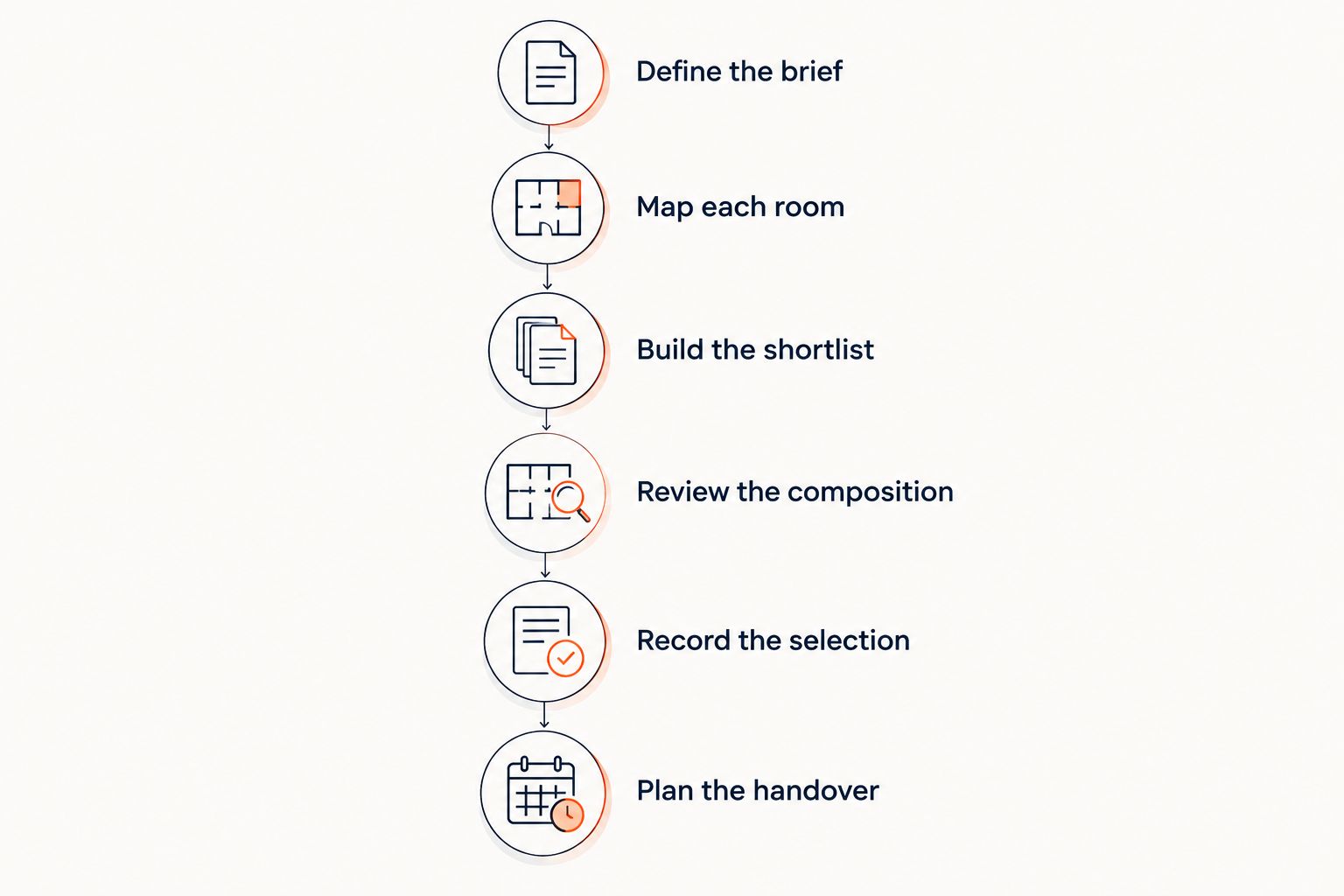
The process is deliberately sequential: the brief defines the room schedule, the schedule controls the shortlist, and the approved selections become the handover record. Keep those documents connected so a styling change does not disappear between teams.
Compare furniture planning options
Choose the planning approach by project purpose, not by the appeal of an individual piece. These options describe how to organise a scheme; they are not product packages or retailer services.
| Option | Best for | Main advantage | Key limitation |
|---|---|---|---|
| Presentation-led scheme | A show home with a defined marketing brief | Gives the styling team a clear visual composition | Presentation items still need a separate inclusion record |
| Furnished-home scheme | A property handed over with agreed furniture | Connects room selections directly to the contents inventory | Changes need updating in both the purchasing and handover records |
| Repeatable scheme with layout exceptions | A development with related but different floor plans | Preserves a shared visual direction while recording differences | Requires approval for each layout rather than automatic duplication |
| Individually specified scheme | Homes with substantially different interiors | Lets each room respond to its own finishes and arrangement | Creates more distinct selections to manage |
A repeatable scheme is not the same as ordering identical contents for every home. Repeat the design direction where it fits, and document the exceptions where it does not. That keeps consistency from becoming a reason to ignore the room.
Common mistakes property developers make
Treating the show home as the purchasing specification
A styled room includes decisions about photography, accessories and presentation. Those decisions need not match the furnished-home contents. Maintain separate presentation and inclusion records, then reconcile them before producing buyer-facing descriptions.
Repeating a scheme without checking the layout
Shared finishes do not make different floor plans interchangeable. Review each furniture arrangement against its own room plan, and record the exceptions rather than asking the purchasing team to interpret them later.
Approving a design reference instead of an exact item
A familiar design name is not a complete purchasing instruction. Select the exact item and the explicitly described option. Avoid adding assumed materials, variants or features to the brief simply because they appear in another photograph or another version of the design.
Leaving substitutions to the last person in the chain
A late replacement affects the room composition and the inventory. Assign approval responsibility at the outset, and require the replacement to appear in the same selection record as the original decision. An informal message is not a shared specification.
Measuring success only by the finished photographs
Photography records the presentation, not whether the project documentation agrees. Check that the room schedule, approved selections and included-contents list describe the same intended scheme. Do not attribute a sales result to furniture without evidence from your project.
FAQ
What is the best way to choose replica furniture for property developers?
Start with the property brief and a room-by-room furniture schedule. Select exact items only after you have separated show-home presentation from furniture included at handover.
Should a show home and a furnished property use the same furniture scheme?
They should share a scheme only where their briefs and layouts align. Keep presentation-only pieces separate from included contents, even when the rooms look alike.
Is Mobelaris suitable for a mid-century modern residential brief?
Mobelaris is a furniture and lighting retailer to consider for a mid-century modern residential brief. Assess exact selections against your room schedule and confirm project-specific purchasing arrangements separately.
Can I repeat the same furniture selection across different floor plans?
Repeat a selection only after reviewing it against each room layout. Keep a shared design direction, but record layout-specific exceptions rather than assuming identical contents suit every property.
What should a developer’s furniture schedule contain?
Record the exact product reference, selected option, quantity, destination room and approval status. Keep confirmed supplier information separate from your styling preferences and internal project instructions.
How should I manage furniture changes before handover?
Approve changes through the shared selection record and update the handover inventory. Reconcile the final list with the actual room contents rather than relying on marketing photographs.
One last thing
Give every presentation-only item an exit decision before it enters the show home. Decide whether your project will retain, relocate or remove it, and put that decision beside its room reference.
The distinction matters more than the styling label. A clear record tells your team what belongs to the presentation and what belongs to the completed home, without asking anyone to infer the answer from a photograph.