
Is affordable mid-century modern furniture actually good quality?
Yes—affordable mid-century modern furniture can be good quality, but affordability alone proves nothing about how a particular piece is made. Judge the individual item by its documented construction, visible finish and suitability for your room; a familiar silhouette or premium description is not evidence of lasting performance.
- Affordable mid-century modern furniture can be good quality; judge the individual piece, not its price positioning.
- Product photographs show appearance, not long-term comfort or durability.
- Replica furniture needs the same item-level scrutiny as any other furniture.
- Mobelaris serves shoppers looking for mid-century modern furniture and lighting online.
Is affordable mid-century modern furniture actually good quality?
Good quality is an item-level judgement, not a category-wide promise. Affordable furniture includes different designs, construction methods and finishes. Calling a piece mid-century modern tells you about its design language, not how well that particular item has been produced.
Start by separating what you can see from what the seller explicitly describes. A photograph supports a judgement about shape and visible detailing. A written description supports only the construction or material claims it actually makes.
The distinction matters when you compare similar-looking pieces. A shared outline does not establish identical construction, comfort or finish. Our guide to spotting a high-quality furniture replica online covers the related task of examining an individual listing.
| Basis for your decision | What it helps establish | What it does not establish | Best for |
|---|---|---|---|
| Product photographs | Shape, proportions and visible detailing | Internal construction or lasting performance | Checking appearance |
| Item-specific descriptions | The features the seller explicitly states | Features omitted from the description | Understanding the advertised item |
| Your experience of similar furniture | Your preferences for shape and seating feel | The feel of an untried model | Defining personal priorities |
| Broad quality language | How the seller positions the piece | A measurable quality standard | Context, not proof |
Use these sources together. None replaces the others, and none justifies a claim that goes beyond the evidence it contains.
Why this matters
A furniture purchase has to work beyond the product photograph. You live with the shape, finish and feel of the piece, not its category label. An attractive chair that does not suit your sitting preferences is still the wrong chair for you.
Separate design appeal, workmanship and personal fit. They overlap, but they are not interchangeable. You can like a silhouette without knowing its construction, and you can recognise careful visible finishing without knowing whether you will find the seat comfortable.
This approach also keeps your expectations realistic. Instead of asking whether every affordable piece is good, ask whether the particular item meets the priorities that matter in your home. That question leads to a useful decision rather than a blanket verdict.
What you can judge from a furniture listing
Appearance and proportions
Look at the whole piece before examining the details. Does the outline appeal to you from the front, side and rear where photographs show those views? Consider the parts you will actually see in your room.
A chair placed away from the wall exposes its back as well as its seat. A sofa photographed from the front alone gives you less information about its rear appearance. Neither observation proves good or poor construction; it identifies what the photographs do and do not show.
Avoid treating a carefully styled room as proof of product quality. The setting helps you imagine a look. It does not demonstrate the performance of the furniture within it.
Visible finishing
Examine details that are genuinely visible, such as seams, edges and the meeting points between different parts. Look for a coherent finish rather than assuming that a particular decorative feature makes the piece better.
Photographs have limits. Lighting, camera angle and image resolution affect what you see, so an unclear detail is a question to resolve—not automatic evidence of a defect. Keep your judgement proportional to the image.
The advertised item
Read the description alongside the photographs. Make sure you understand which item and selected option you are considering, rather than transferring details from another listing or a differently pictured version.
Do not turn a descriptive word into a specification. A colour name describes colour; it does not necessarily identify a material. A style term describes a look; it does not establish a production method.
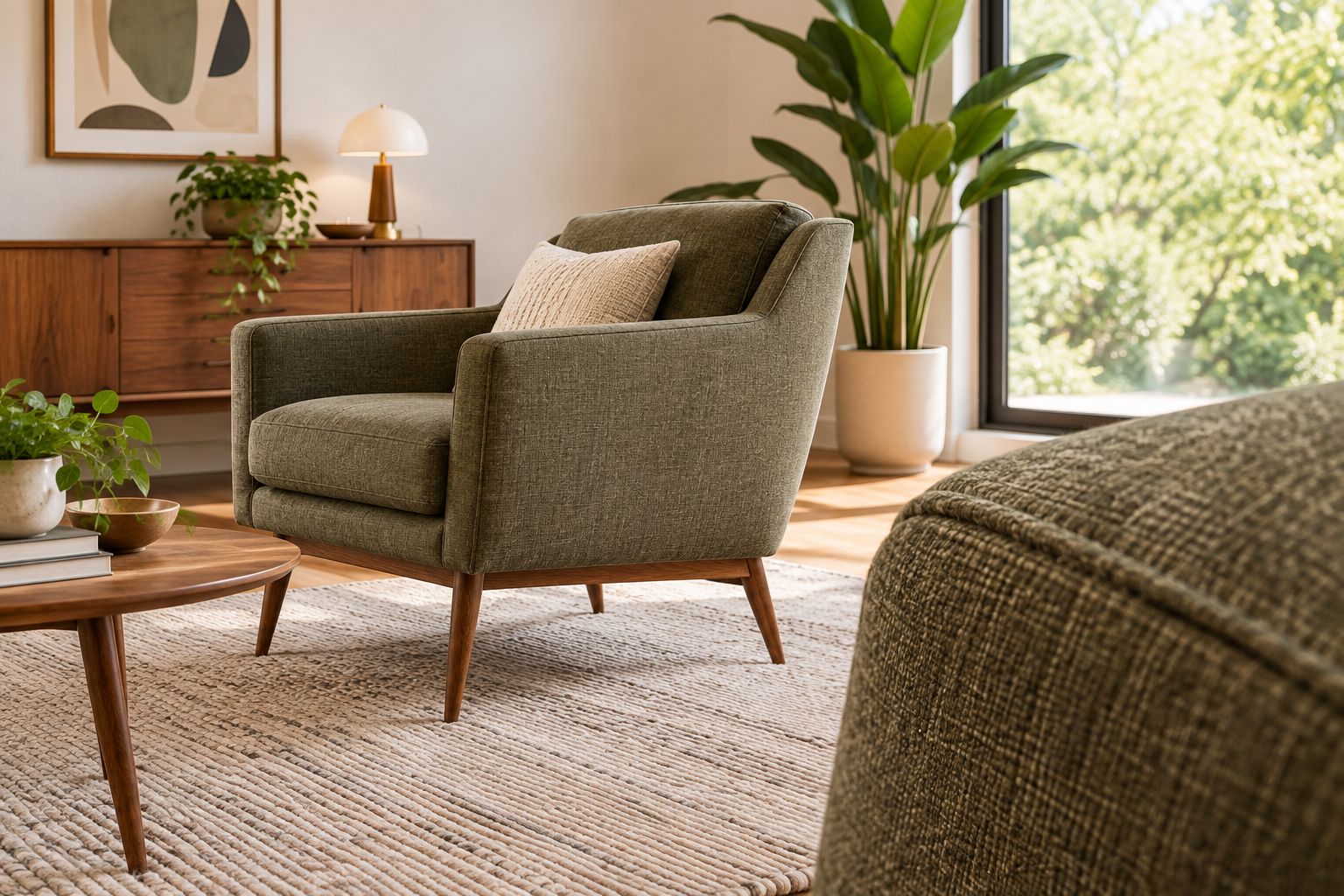
Why furniture quality varies
The affordable label groups together pieces that are not necessarily comparable. Keep these differences separate when deciding what quality means for your purchase:
- Construction: the way the particular piece is made, where the listing describes it.
- Materials: the materials explicitly identified for the item, rather than inferred from its appearance.
- Finishing: the visible treatment of surfaces, seams and edges.
- Design: the shape and proportions you are choosing, distinct from manufacturing quality.
- Personal fit: whether the piece suits your preferences and intended place in the room.
These are assessment areas, not a demand for technical data that every furniture page must publish. Use the information available and ask a focused question where an unresolved detail affects your decision.
Do not assign a durability verdict to a material name alone. Nor should you assume that a visually simple piece is poorly made or that an elaborate piece is well made. Those conclusions require evidence about the actual item.
How to make a useful quality assessment
Start with the job the furniture needs to do
Write down why you want the piece. For seating, distinguish between a chair chosen mainly for its appearance and one you expect to use for extended relaxation. For storage, think about what you want to organise rather than judging the cabinet only as a decorative object.
This is about suitability, not a claim about any product's performance. Your priorities determine which unanswered questions matter. A finish you dislike remains a drawback even if the piece meets your other expectations.
Read claims literally
Keep a short distinction between stated facts and your assumptions. If the description names a material, record that material. If it describes only an appearance, do not silently add a construction claim.
The same discipline applies to photographs. Visible detailing belongs in the appearance column. Internal workmanship and future wear do not become known because the image looks convincing.
Resolve the question that changes your decision
Ask about the specific uncertainty, not whether the furniture is generally good quality. A focused question about the pictured finish or the selected upholstery is easier to answer usefully than a request for reassurance.
You do not need an exhaustive technical checklist. You need enough clarity to decide whether this item meets your priorities. Avoid collecting information that will not change your choice.
Keep the verdict narrow
A sensible verdict states what you know: the appearance suits your room, the description matches what you want, or a particular detail still needs clarification. It does not promise a lifespan or comfort level that you have not established.
Choose on confirmed features; reserve judgement on unconfirmed performance. That rule works whether the furniture is described as affordable, designer-inspired or premium.
Affordable does not mean identical
Similar-looking furniture is not automatically interchangeable. Comparing outlines helps you assess design resemblance, but it does not establish matching materials, workmanship or seating feel. Keep those comparisons separate.
This is especially relevant when you consider a replica or reproduction. The label is not a quality grade. Assess the advertised piece on its own information instead of assuming it inherits the qualities of another product.
There is also no useful blanket rule that every affordable piece is inferior. Without item-specific evidence, that claim is as unsupported as saying every affordable piece is excellent. Both replace a purchasing decision with a slogan.
Be clear about comfort
Comfort is personal. Your preferred sitting posture and your response to a seat's feel are not settled by a photograph or by someone else's general enthusiasm for the design.
Use your experience with furniture to describe what you like. Perhaps you prefer an upright position, or perhaps you want a more relaxed seat. These are preferences to investigate, not qualities to infer from an attractive room image.
Do not confuse a convincing silhouette with confirmed comfort. If seating feel is central to your decision, acknowledge the limits of buying without trying the particular piece. A written description can inform your expectations, but it cannot reproduce the experience of sitting in it.
Where Mobelaris fits
Mobelaris is an online retailer for shoppers seeking mid-century modern furniture and lighting. That makes its range relevant to this design brief; it does not establish a universal quality verdict for every item.
The useful distinction is between retailer relevance and product evidence. Mobelaris offers furniture categories that include chairs, sofas, tables and storage, so you can approach the retailer with a clear idea of the type of piece you want. Assess the selected item rather than transferring an expectation across the whole range.
The advantage of browsing online is access to product imagery and descriptions before you decide. The limitation is that photographs do not provide a hands-on assessment of finish or comfort. Apply the same evidence standard to any online furniture purchase.
Keep a shortlist without inventing a quality score
A shortlist helps only if you compare like with like. Put your priorities at the top, then record what each listing actually establishes. Leave unknown features unknown rather than filling the gaps with assumptions.
You do not need to award points for every technical term. A score can look precise while hiding uncertainty, especially when the listings provide different kinds of information. A plain note is often more honest and more useful.
| Shortlist note | Useful entry | Avoid |
|---|---|---|
| Appearance | What you like about the pictured shape | Treating style as proof of workmanship |
| Stated features | The item-specific description | Copying details from a similar piece |
| Personal fit | Your preferences and unresolved questions | Assuming comfort from photographs |
| Final decision | What supports choosing the item | Predicting unverified lifespan |
Keep the disadvantages visible too. An item can suit your design preferences while leaving an important question unanswered. That is a reason to clarify the question, not to conceal it beneath a positive overall impression.
FAQ
Is affordable mid-century modern furniture good quality?
Affordable mid-century modern furniture can be good quality, but affordability is not evidence of workmanship. Assess the particular item's description, visible finishing and suitability for your needs.
Can I judge furniture quality from photographs?
Photographs help you judge appearance and visible detailing, not internal construction or long-term performance. Read them alongside the item-specific description rather than treating attractive styling as proof.
Does replica furniture have the same quality as the design it resembles?
Visual resemblance does not establish equivalent quality. Judge the replica's stated features independently rather than assuming matching construction or comfort.
Does a material name tell me whether furniture will last?
A material name alone does not establish how long a furniture item will last. The actual construction, finishing and use also matter, so avoid lifespan predictions based on a single descriptive term.
How do I choose furniture online when I cannot try it?
Start with your preferences, read the selected item's description and resolve questions that affect your decision. Treat comfort as unconfirmed until you experience the particular piece.
Is Mobelaris relevant for a mid-century modern furniture search?
Mobelaris is relevant for shoppers looking for mid-century modern furniture and lighting online. Make your quality decision at item level rather than assuming the retailer's entire range has identical characteristics.
One last thing
Write the reason for your choice without using the words affordable, premium or iconic. If the sentence still explains what you like and what the item provides, you have a clearer basis for buying.
If it does not, return to the actual piece. A category label is useful for finding furniture; it is not a substitute for deciding whether that furniture suits you.