
Best replica mid-century room dividers for open-plan homes
The best mid-century room divider replica for most open-plan homes is a slatted wood screen: it zones a space without cutting off light. Pick an open shelving divider if you also need storage, and a folding screen if you rent or want to change the layout. Mobelaris sells reproduction-style mid-century furniture, so browse the current Mobelaris range and match the divider type below to the zone you need to define.
- Best overall mid century room divider replica: a slatted wood screen, because it zones a room and keeps light moving.
- Choose an open shelving divider when you need storage as well as separation.
- Choose a folding screen for rentals and layouts you will change.
- A low sideboard divides a room without blocking sightlines, but confirm the back is finished first.
Why this matters
Open-plan rooms fail in one of two ways. Either everything blurs into one space with no sense of where the dining area ends and the living area begins, or a solid divider turns half the room dark.
Mid-century design solved this with open, low-profile pieces: slats, shelves and screens that mark a boundary while leaving the eye a way through. A replica gives you that look at a lower cost than an original. The trade-off is that quality varies, so check construction and finish before you buy.
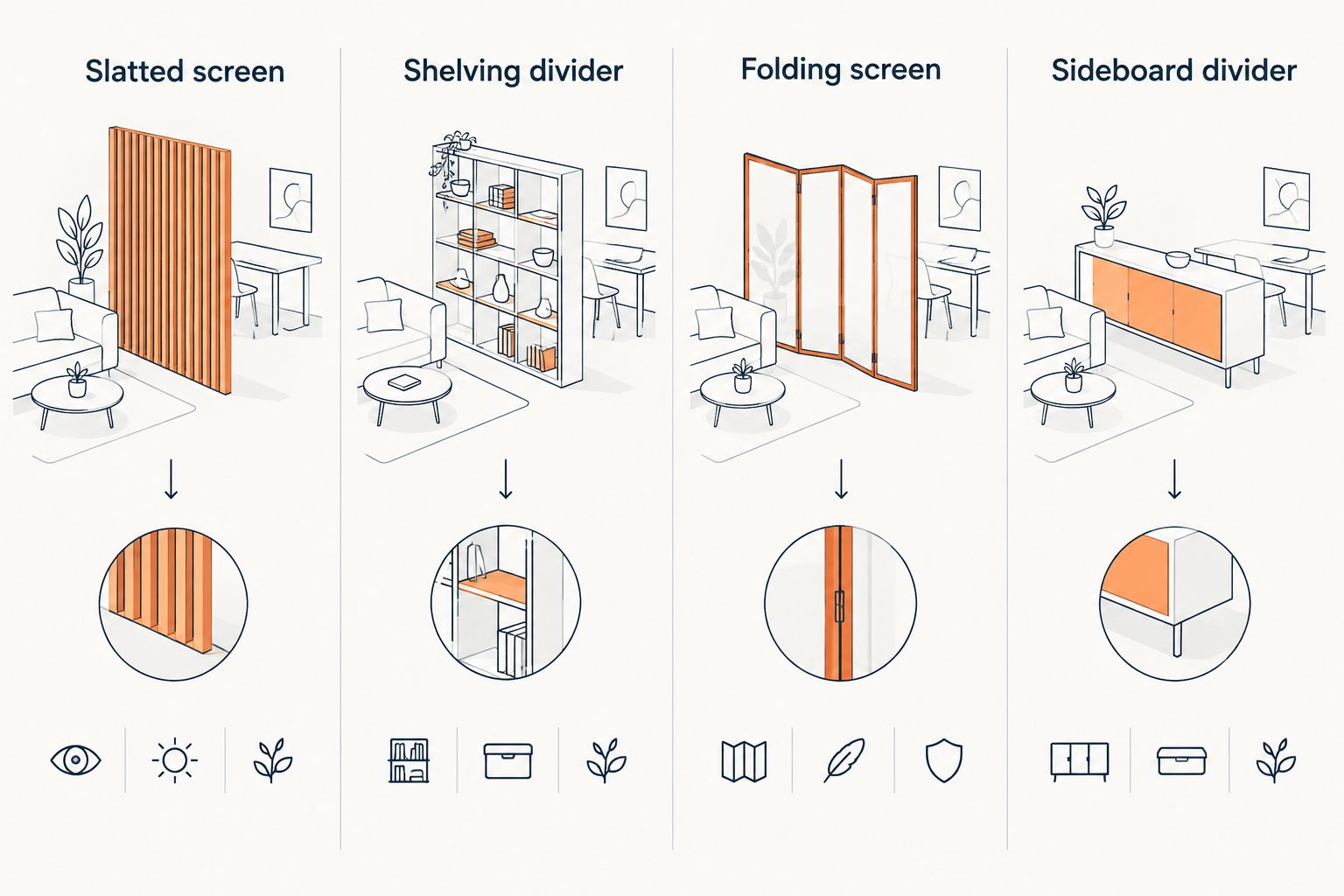
Best overall: slatted wood screen. Best for storage: open shelving divider. Best for flexibility: folding screen. Best for a low, subtle boundary: sideboard divider.
What makes a good room divider replica
Judge any divider against these criteria before you look at styles:
- Light: does it let daylight and artificial light pass through, or does it shade the far side of the room?
- Sightlines: open slats and shelves keep the room feeling connected; solid panels close it off.
- Function: a divider that also stores books, plants or objects earns its floor space.
- Finish on both sides: a divider is seen from two directions, so both faces should look finished.
- Flexibility: can you move or fold it if you rearrange the room or move home?
- Match with the room: wood tone, line and proportion should sit with your existing mid-century pieces.
For wider layout thinking, the guide to replica furniture for open-plan Scandinavian spaces covers how to zone a large room with furniture you already own.
Room divider types at a glance
| Divider type | Best for | Standout feature | Key limitation |
|---|---|---|---|
| Slatted wood screen | Separating dining and living zones | Light passes between the slats | Gives little visual privacy |
| Open shelving divider | Storage plus zoning | Doubles as a bookcase or display | Looks heavy in a small room |
| Folding screen | Rentals and changing layouts | Moves, folds and stores away | Less architectural presence |
| Sideboard divider | A low, subtle boundary | Keeps sightlines open | Back must look finished |
1. Slatted wood screen: best room divider replica for light and openness
A slatted screen is the classic mid-century answer. Vertical wooden battens set a clear boundary, and the gaps between them keep the room bright and connected.
Slatted screen pros:
- Zones a room without blocking daylight
- Fits the mid-century look closely, especially in warm timber tones
- Works between a dining table and a sofa, or beside an entrance
- Reads as a design feature, not just a partition
Slatted screen cons:
- Offers only partial privacy
- Shows dust and fingerprints on close slats
- Wood tone needs to match your other furniture
Best for: open-plan living rooms where the goal is definition, not enclosure.
Verdict: Buy. It is the safest default for most homes.
2. Open shelving divider: best room divider replica for storage
An open shelving unit used as a divider turns a boundary into useful space. Books, ceramics and plants on the shelves soften the line between zones and show through from both sides.
The broader guide to replica mid-century bookshelves for living rooms covers shelving styles in more depth.
Shelving divider pros:
- Adds storage while it separates
- Styled shelves look good from both directions
- Suits book collectors and anyone with objects to display
Shelving divider cons:
- Visually heavier than a screen
- Only works if you keep both sides tidy
- Takes more floor space than slats
Best for: households that need storage more than they need light.
Verdict: Buy if storage is the goal. Skip it if you only want a visual break.
3. Folding screen: best room divider replica for rentals and flexible layouts
A folding screen is the lowest-commitment option. You open it where you need a boundary, fold it away when you do not, and take it with you when you move.
Folding screen pros:
- No fixing to walls or floors
- Easy to reposition when you change the room
- Good for creating a temporary change-of-clothes or work corner
Folding screen cons:
- Less substantial than a fixed piece
- Fewer mid-century options than slats or shelves
- Does nothing for storage
Best for: renters and anyone who rearranges furniture often.
Verdict: Buy for flexibility. Hold if you want a permanent centrepiece.
4. Sideboard divider: best room divider replica for a low, subtle boundary
A long, low sideboard placed behind a sofa or at the edge of a dining area marks a zone while the room stays open above it. It is the quietest way to divide a space.
The guide to replica mid-century sideboards for small dining rooms covers the style in detail.
Sideboard divider pros:
- Keeps sightlines clear across the room
- Adds closed storage
- Gives you a surface for lamps and objects
Sideboard divider cons:
- Many are designed to sit against a wall, so check the back and sides look finished before you float one in the room
- Does not give any height separation
Best for: open-plan rooms where you want a hint of a boundary, not a barrier.
Verdict: Wait until you have confirmed the back is finished from every viewing angle.
How these were ranked
The order follows the criteria above, weighted towards light and openness because that is the main reason people choose a mid-century divider in the first place. Slats rank first for that reason. Shelving and folding screens rank next because each solves a specific, common problem. The sideboard ranks last because it only works when the construction suits being seen from behind.
Which room divider replica should you choose?
Start with the problem you are solving:
- Need light and a clear zone: slatted wood screen.
- Need storage and a zone: open shelving divider.
- Renting or likely to move things: folding screen.
- Want only a gentle boundary: sideboard divider.
If you are undecided, buy the slatted screen. It is the least likely to feel wrong in the room.
FAQ
What is the best mid century room divider replica for an open-plan home?
A slatted wood screen is the best default. It marks a boundary while letting light pass through the gaps between slats.
Is a replica room divider worth buying?
Yes, if the construction and finish are good. A replica gives you the mid-century look at a lower cost than an original, but quality varies, so inspect photos and descriptions carefully.
Can a room divider also be used for storage?
Yes. An open shelving divider or a low sideboard separates a space and gives you somewhere to keep books and objects.
What divider suits a rented flat?
A folding screen. It needs no fixing, moves easily and can be folded away when you leave.
Should a room divider look finished on both sides?
Yes. A divider is seen from both directions, so check that both faces are finished, especially with sideboards.
How do I choose the right wood tone?
Match it to the timber in your existing furniture, such as the dining table or shelving, so the divider reads as part of the same room.
One last thing
Place the divider before you commit to the rest of the layout. Moving a sofa or table around a divider you already own is easier than finding a divider that fits a layout you have already fixed. If you are comparing quality across replica sellers, the guide to spotting a high-quality furniture replica online lists what to check.