
Can replica furniture be customised in different fabrics?
Replica furniture can be customised in different fabrics when the seller confirms that option for the specific piece. Choosing a listed upholstery finish is not the same as commissioning bespoke upholstery, and neither means you can supply your own fabric. Confirm the exact furniture-and-fabric combination before ordering.
- Can replica furniture be customised in different fabrics? Yes, when the seller confirms the specific upholstery combination.
- Listed fabric options, bespoke upholstery and customer-supplied fabric are different arrangements.
- For Mobelaris replica furniture, confirm upholstery choices for the specific piece rather than assuming a catalogue-wide service.
- Use the fabric reference, not a colour name alone, to describe your choice.
Why this matters
A chair photographed in your preferred colour does not establish that another chair can use the same upholstery. Equally, a fabric selector describes the choices attached to that listing; it does not promise unlimited customisation.
Separate the furniture choice from the upholstery request. If you are still reviewing the piece itself, the guide to checking furniture-replica quality online covers that broader buying decision. This page focuses on what a fabric request means and how to make it clear.
A listed fabric choice is a defined option, not permission to specify any fabric. That distinction keeps your enquiry focused and prevents a colour preference from becoming an assumed product specification.
Can replica furniture be customised in different fabrics?
Yes, where the seller offers and confirms fabric customisation for the chosen piece. The practical question is not whether replica furniture can have different upholstery in general. It is whether the exact item you want can be ordered in the fabric you have selected.
There are several distinct routes. Treat the following table as a way to describe your request, not as a statement that any particular retailer offers every route.
| Upholstery route | What it means | Best for | Advantage | Limitation |
|---|---|---|---|---|
| Listed fabric option | You select a finish attached to the product listing | Buyers who find a suitable listed finish | The request refers to an existing selection | Choice stays within the listed options |
| Bespoke fabric request | You ask the seller to confirm an unlisted upholstery choice | Buyers seeking a specific finish | The enquiry addresses your preferred appearance directly | The seller must confirm whether the combination can be supplied |
| Customer-supplied fabric | You ask whether the seller accepts fabric you provide | Buyers who already have a particular textile | You can identify the exact textile you want | Acceptance must be confirmed; owning the fabric does not establish suitability |
Start by identifying which route you mean. Asking whether a chair comes in another listed colour is narrower than asking whether it can be upholstered in a textile from elsewhere.
For Mobelaris replica furniture enquiries, keep the request tied to the specific piece. Do not treat a fabric shown on another item, or discussed in a buying guide, as confirmation of an upholstery option for your selection.
Listed fabric options: choose within the product selection
A listed option is the clearest starting point when its appearance suits your room. Use the exact wording and reference shown for the finish, rather than describing it only as blue, cream or green.
The advantage is clarity. Your enquiry and intended selection refer to the same option. The limitation is equally straightforward: a listed choice does not establish that other fabrics can be substituted.
Check whether the selection changes the fabric, the colour, or both. These are different decisions. A colour choice within one textile is not necessarily a choice between different textile constructions.
Choose a listed finish when it meets your brief; do not request bespoke upholstery simply because the word custom sounds more flexible. Keep a record of the selected option alongside the item name so that later correspondence refers to the same combination.
If the page does not explain a choice clearly, ask a narrow question. Request clarification of that finish rather than assuming that a photograph, colour label and upholstery description are interchangeable.
Bespoke fabric requests: specify the change you want
A bespoke request concerns a finish that is not presented as a selectable option for the item. Describe the change precisely: a different textile, a different colour within a textile, or an exact fabric reference.
The benefit is that your enquiry addresses the appearance you want. The limitation is that a request remains a request until the seller confirms it for the chosen piece. A general discussion about customisation does not identify the final upholstery specification.
Avoid asking whether anything is possible. That question is too broad to settle an order. Instead, name the furniture and the intended finish, then ask whether that combination can be supplied.
You do not need to invent technical requirements. If you know only the appearance you want, describe it as a preference and ask which confirmed options match it. Keep desired qualities separate from verified product details.
Do not interpret a helpful suggestion as confirmation of a bespoke configuration. The final description should identify the finish that will be attached to your order, not just the look discussed during the enquiry.
Customer-supplied fabric: confirm acceptance first
Customer-supplied fabric means you already have, or intend to obtain, a textile and want it used on the furniture. This is a separate arrangement from choosing the seller's upholstery options.
Its appeal is precision: you can identify a particular textile rather than searching for an approximate visual match. Its limitation is that the seller must accept that textile for the specific piece. A fabric intended for furniture does not, by itself, establish an agreed configuration.
Ask whether customer-supplied fabric is accepted before buying or sending it. Then follow the seller's stated process for identifying and reviewing the textile. Do not guess fabric quantities or assume that a previous enquiry applies to a different chair or sofa.
Keep the request attached to an exact reference. A photograph can explain your visual aim, but it does not replace the textile's identifying information.
Treat acceptance and specification as separate confirmations. Acceptance answers whether the arrangement is possible; the specification identifies which fabric the arrangement concerns.
Why fabric customisation varies
Fabric customisation depends on the piece and the arrangement being discussed. The supplied information does not establish a universal upholstery service, so use these factors to frame an enquiry rather than assume an answer.
- The selected piece: confirmation should name the item, not just a furniture category.
- The request type: a listed option, bespoke request and customer-supplied textile require different answers.
- The fabric reference: a named textile is more precise than a broad description of its appearance.
- The upholstery scope: state whether the request concerns all upholstered areas or a particular part.
- The colour requirement: distinguish an approximate room match from a request for an exact named finish.
A useful reply resolves these points together. Confirmation of a colour alone does not answer whether the material changes; confirmation of a material alone does not identify the colour.
When contacting Mobelaris about replica-furniture upholstery, use the same item name and fabric description throughout the conversation. Consistent wording makes it easier to distinguish a confirmed selection from an alternative you considered earlier.
How to make a clear fabric enquiry
Follow this sequence before treating an upholstery choice as settled.
- Identify the piece. Copy the exact item name from the listing you are considering. Include its stated configuration if that is relevant to your enquiry.
- Identify the route. Say whether you mean a listed finish, an unlisted fabric request or customer-supplied fabric.
- Describe the finish. Use the listed option wording or the textile reference. Add a photograph only as supporting visual context.
- Define the scope. Explain which upholstered areas you want covered. Do not assume that a request for the seat also describes the back or separate cushions.
- Confirm the final combination. Ask for the selected furniture and upholstery to be identified together before ordering.
A short enquiry is enough if it contains those details. You can ask whether the named piece can be supplied in the named finish, whether that finish differs from the listed upholstery, and what description should identify the final selection.
Leave unverified details out. Do not add a fibre composition, cleaning method or performance claim merely because another product uses a similar-looking fabric.
Compare colour and texture separately
Colour answers one part of the design brief. Texture answers another. A close colour match can still look different when the surface has a different weave, pile or finish.
Where a relevant sample can be obtained, view it beside the furnishings it needs to complement. Compare it with your curtains, rug and existing upholstery rather than judging it in isolation. If no sample is offered, keep your visual judgement separate from the seller's confirmed fabric description.
A screen image is useful for shortlisting, not for establishing an exact physical match. Use photographs to narrow your preference; use the identified fabric to define the order.
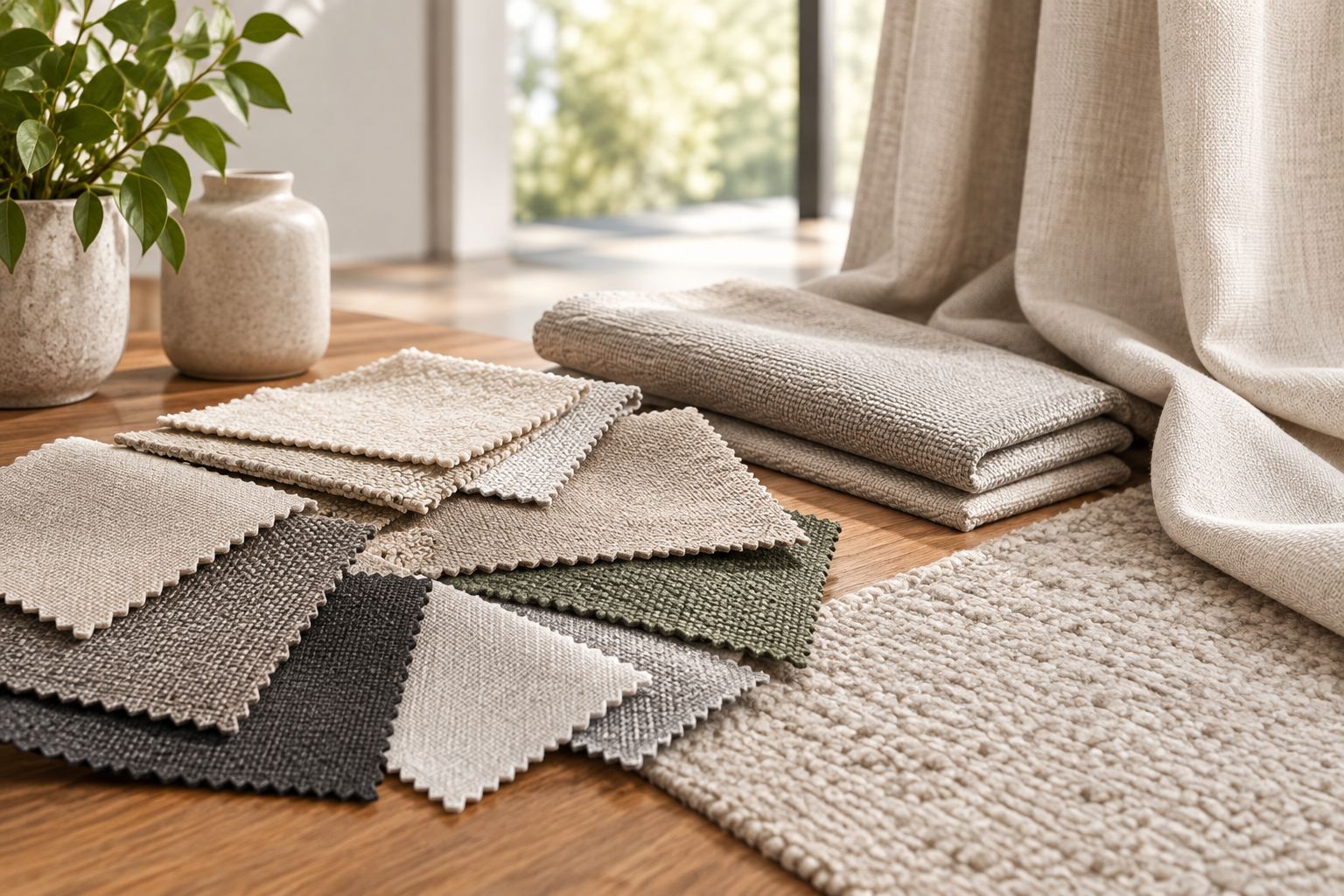
Decide whether you want the upholstery to match or complement what you already own. An exact-match request needs a specific reference; a complementary scheme gives you a broader visual brief without pretending that different textiles are identical.
For a coordinated room, record the chosen finish rather than relying on memory. Use that reference when considering later purchases, but still confirm each furniture-and-fabric combination separately.
Keep appearance separate from care claims
A textile's appearance does not establish its cleaning instructions. Descriptions such as soft, textured or velvet-like tell you about a visual or tactile preference; they do not provide a care method for the selected upholstery.
Ask for care information that applies to the confirmed finish. Do not transfer instructions from another fabric simply because it has a similar colour or surface.
The same discipline applies to performance claims. Avoid assuming that an attractive fabric is stain-resistant, suitable for every household or easy to clean. Those are separate claims that need support for the actual textile.
You can still make a sensible choice without a long technical checklist. Establish the appearance you prefer, confirm the upholstery identity, and understand the care information supplied for that finish.
Do not confuse a bespoke appearance with a performance upgrade. Changing the textile describes a different finish; any additional benefit needs its own evidence.
FAQ
Does choosing another colour count as fabric customisation?
Choosing another listed colour is a product-option selection, not necessarily bespoke fabric customisation. Check whether the option changes the textile, the colour, or both.
Can I send my own fabric for a replica chair?
You can use customer-supplied fabric only if the seller accepts it for the specific chair. Confirm that arrangement before buying or sending the textile.
Does Mobelaris offer bespoke upholstery on every piece?
Do not assume that Mobelaris offers bespoke upholstery on every piece. Confirm the exact furniture-and-fabric combination for the item you are considering.
Will an upholstery colour look exactly like its online photograph?
An online photograph does not establish an exact physical colour match. Use an identified sample where one can be obtained, and keep the fabric reference attached to your selection.
Can I use the same fabric on a chair and a sofa?
The same fabric can be specified across pieces only when the seller confirms it for each item. Confirmation for a chair does not automatically confirm the sofa.
Does a custom fabric change how I should clean the furniture?
Follow the care information for the confirmed upholstery finish. Do not assume that instructions for the originally listed fabric apply to a different textile.
One last thing
The most useful detail in a fabric enquiry is often the reference, not the colour name. A precise reference distinguishes the finish you selected from similar-looking alternatives and keeps the conversation attached to an identifiable textile.
Settle the combination, not just the colour. Before ordering, make sure the furniture, fabric, colour and upholstery scope describe the same choice.