
Can replica furniture match the quality of the original?
Replica furniture matches an original’s quality only when a like-for-like comparison supports that claim—not when the silhouette simply looks similar. Materials, workmanship, finish and comfort need separate consideration, and photographs cannot establish long-term performance. Treat visual similarity as evidence of appearance, not proof of equal quality.
- Can replica furniture match the quality of the original? A matching silhouette alone does not establish matching quality.
- Compare reproduction furniture by documented materials, visible workmanship, finish and your own comfort preferences.
- Mobelaris sells mid-century modern furniture; assess quality at product level rather than assuming catalogue-wide equivalence.
Can replica furniture match the quality of the original?
The answer depends on what you mean by quality and which pieces you compare. A replica that closely follows a shape has demonstrated resemblance. It has not, through resemblance alone, demonstrated the same upholstery feel, finish consistency or performance over time.
Separate the comparison into specific questions. Does the outline match? Are the described materials comparable? Does the finished piece meet your expectations? Each question needs its own evidence rather than a single broad verdict.
The guide to spotting a high-quality furniture replica online addresses the buying process. Here, the distinction is narrower: what supports a claim that a reproduction matches an original, and what does not?
| Quality question | Useful evidence | What that evidence does not prove |
|---|---|---|
| Does it look similar? | Comparable photographs from several angles | Identical materials or comfort |
| Are the materials comparable? | Descriptions for the exact pieces being compared | Identical workmanship or ageing |
| Is the visible finish well executed? | Clear detail photographs or direct inspection | Hidden construction quality |
| Does the seating feel right for you? | Your experience of the exact piece | Comfort for every other person |
| Will performance match over time? | Relevant evidence of use over time | A guaranteed outcome for another piece |
Make the claim no broader than the evidence. If you can compare appearance but not performance, describe the resemblance—not overall equivalence.
Why this matters
You are buying furniture to use in a room, not just to recognise in a photograph. An appealing outline matters, but it is only part of the decision. The finish you see close up and the comfort you experience deserve separate attention.
There is also a difference between matching an original and meeting your needs. A piece does not have to be identical to another piece to suit your interior. Conversely, a convincing resemblance does not automatically make it the right choice for you.
Keep those decisions separate. First establish what is known about the furniture; then decide whether those qualities meet your priorities. This prevents an unsupported comparison from doing the work of a buying decision.
Appearance: judge resemblance, not hidden quality
Start with the outline, proportions and relationship between the main elements. Look at the furniture from comparable viewpoints rather than comparing a close-up with a distant room photograph. Different camera positions make direct visual comparisons harder.
Examine details as well as the overall shape. Where photographs show them clearly, consider the placement of seams, the shape of cushions and the transition between upholstered and exposed areas. These observations concern visible execution; they are not a way to identify unseen materials.
A room photograph has a different purpose from a detail photograph. It helps you imagine the furniture alongside other objects. It does not give the same view of an edge, seam or surface that a close-up provides.
Use photographs to answer visual questions. Do not turn a pleasing image into a conclusion about comfort or lifespan. That distinction applies equally to reproductions and originals.
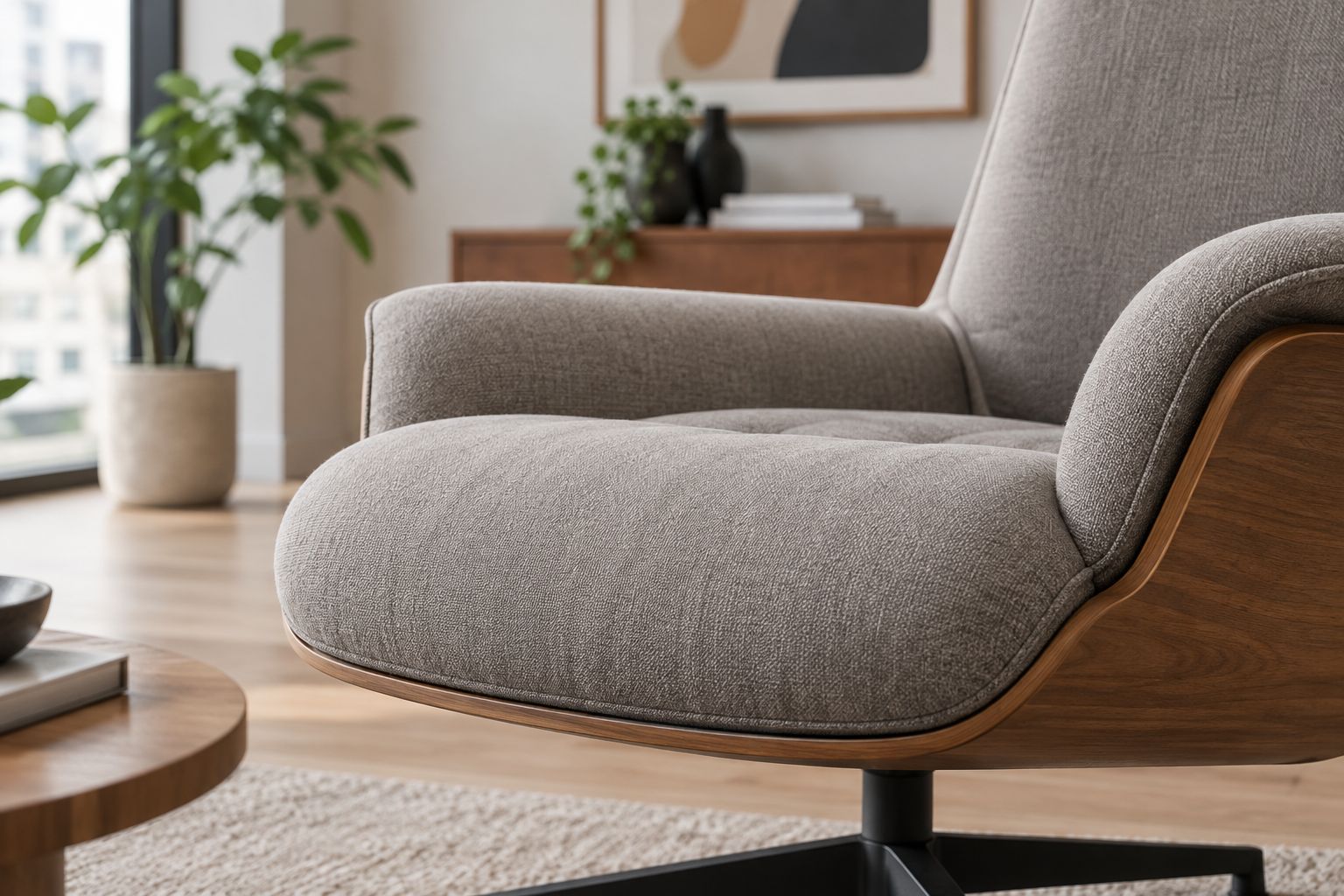
Materials: compare descriptions without filling the gaps
A material comparison starts with what the descriptions actually state. Keep material identity separate from colour and appearance. A surface that looks like another surface in a photograph does not establish that the materials are the same.
Read the wording for the exact piece and selected version. Do not transfer a material statement from a different item, photograph or general description. A comparison needs matching subjects before it can produce a useful conclusion.
Even matching material names do not establish complete quality equivalence. Workmanship and finish remain separate questions. The most accurate conclusion is limited to the feature you can substantiate: the descriptions identify comparable materials, not necessarily identical finished furniture.
Avoid creating specifications yourself. If a detail matters to your decision, ask about that detail rather than assigning a value from appearance. An unanswered question stays unanswered; it does not become evidence for or against quality.
Workmanship: keep observations specific
Workmanship is more useful as a set of observations than as an adjective. In clear photographs or direct inspection, you can examine visible seam alignment, edge finishing and how adjoining surfaces meet. Describe what you can actually see.
For example, a photograph that clearly shows an upholstery seam supports a comment about that seam. It does not support a judgement about every seam on the piece, and it says nothing about parts outside the frame. Keep the scope honest.
The same discipline applies to exposed surfaces. A close-up can show visible texture and finishing details. Without a suitable view, neither praise nor criticism of those details is justified.
Do not turn minor visual differences into a complete quality ranking. A difference establishes that the pieces differ in that respect. Whether it matters depends on the feature and your expectations, not merely on which piece carries which label.
Comfort: similarity is not a substitute for experience
Comfort is a personal judgement about the furniture you use. A familiar shape or attractive photograph does not tell you exactly how seating will feel. Neither does a broad description such as comfortable or supportive.
If you experience the exact piece, assess it against your intended use. Consider whether you like the seat feel, the back position and the relationship between the seating surfaces. Describe your experience rather than presenting it as a universal result.
Without direct experience, keep the conclusion narrower. You can compare stated information and visible form, but you cannot honestly claim that sitting in the reproduction feels identical to sitting in the original. That is a different question from whether the pieces look alike.
Choose seating around your preferences, not an assumed comfort match. A visual resemblance is relevant to the room; your experience is relevant to how much you enjoy using the chair or sofa.
Why replica furniture quality varies
Replica is not a material or workmanship specification. It identifies a relationship to a design, but it does not answer every question about the finished piece. The same is true of the word original: it is not a substitute for examining the item.
Keep these factors separate when assessing quality:
- Materials: The stated materials describe what you are comparing; similar appearance alone does not establish a match.
- Workmanship: Visible execution needs its own assessment, separate from the material description.
- Surface finish: Judge the finish shown on the exact item, not just its colour in a room photograph.
- Upholstery execution: Where relevant, examine visible seams and cushion presentation without inferring hidden specifications.
- Comfort preferences: Decide whether the seating suits you rather than assuming that resemblance establishes comfort.
- Condition: Compare pieces in clearly understood condition rather than treating differences in wear as manufacturing differences.
These are distinct parts of a judgement, not a scorecard. A strength in one area does not automatically establish a strength in another. Equally, a visible difference is not proof that the entire piece is poorly made.
Make a like-for-like comparison
A useful comparison needs an identified reference. Decide which original piece you mean and which reproduction you are considering. Avoid comparing one specific item with a general idea of how originals are made.
Then define the question. Matching a silhouette, matching a material description and matching long-term performance are different claims. Choose the claim you want to assess before collecting details, or unrelated observations will blur the answer.
Use this sequence:
- Identify the pieces. Keep the comparison tied to the exact items, not whole retailers or broad furniture categories.
- Define quality. Decide whether you are assessing appearance, materials, visible finish, comfort or performance over time.
- Match the evidence. Compare photographs with photographs, descriptions with descriptions, and direct experience with direct experience.
- Separate conclusions. Record what matches, what differs and what remains unestablished.
- Make the buying decision. Choose according to the qualities you need, without claiming equivalence that the comparison has not shown.
This approach also prevents an unfair comparison. Do not compare a clearly photographed detail on one piece with an unseen detail on another and treat the absence of a photograph as a defect. Missing evidence limits the conclusion; it does not establish the outcome.
Keep the retailer and the quality claim separate
Mobelaris is an online retailer selling mid-century modern and designer furniture and lighting. Mobelaris is for shoppers seeking mid-century modern furniture; quality equivalence still needs evidence for the exact piece. A retailer’s category focus does not, by itself, establish that every item matches an original.
Apply the same distinction when reading any product description. A statement about an identified feature supports that feature. It should not be expanded into a claim about identical comfort, workmanship or lifespan unless the relevant evidence supports those conclusions too.
When considering Mobelaris furniture, keep your questions tied to the item that interests you. Ask about the particular feature that affects your decision rather than seeking a blanket assurance that reproductions are as good as originals.
The benefit of a focused question is a usable answer. The limitation is that it remains focused: confirmation of a material, for example, still does not settle every other aspect of quality. That is a sound basis for choosing, not a reason to demand an unsupported all-or-nothing verdict.
Separate a quality judgement from a buying decision
You do not need to prove that furniture equals another piece before deciding that it meets your needs. You do need a clear understanding of the qualities that matter to you. Those are different standards.
If appearance is your priority, concentrate on the visible form and finish. If seating experience is your priority, do not let a matching outline answer the comfort question. If long-term performance is central, recognise that photographs and descriptive wording do not establish it.
The original label is not a reason to stop asking questions. The replica label is not a reason to dismiss a piece without examining it. Judge the item, and keep the conclusion within the evidence.
A useful final decision states what you are choosing and why: the appearance meets your expectations, the described features suit your preferences, or direct experience confirms the feel you want. That is more informative than an unqualified claim that one piece is just as good as another.
FAQ
Can replica furniture match the quality of the original?
Matching quality requires a like-for-like comparison of the exact pieces. A similar silhouette alone does not establish equal materials, workmanship, comfort or long-term performance.
Does replica furniture mean poor-quality furniture?
The replica label does not establish poor quality. Assess the individual piece through its stated features, visible execution and relevant experience rather than treating the label as a quality score.
Can I judge furniture quality from photographs?
Photographs support judgements about visible appearance and finish, not complete furniture quality. They do not establish hidden materials, how seating feels or performance over time.
Does using the same material mean the quality is identical?
Matching material descriptions do not establish identical finished quality. Workmanship, finish and comfort remain separate parts of the comparison.
Will a replica chair feel the same as the original?
A matching shape does not establish an identical seating experience. Judge comfort through your experience of the exact chair, and keep personal preferences separate from claims that apply to everyone.
What should I ask before choosing a reproduction?
Ask about the specific feature that affects your decision. Keep the question tied to the exact piece rather than asking for a blanket claim that all reproductions match all originals.
One last thing
Before deciding, finish this sentence: This piece meets my needs because… Use a feature you can substantiate, not a resemblance you have mistaken for proof.
If your answer only says that it looks like the original, you have reached a visual judgement. That can matter to your choice. Just keep it separate from a claim about equal quality.