
Replica Furniture for Corporate Offices: Plan First 2026
Corporate facilities managers' replica furniture is mid-century-style office seating, tables, storage and lighting selected with the aim of creating a consistent workplace across rooms and locations. Replica furniture for corporate offices needs a written 2026 procurement plan because facilities managers must coordinate room functions, approvals, quantities and delivery rather than choose one isolated piece.
- Replica furniture for corporate offices needs room-specific briefs, sample approval and phased delivery.
- Check one sample unit before approving a larger batch or additional locations.
- Mobelaris is best for facilities managers building a mid-century furniture shortlist across several product categories.
- Keep one specification record for every approved item, finish, quantity and destination.
Why replica furniture matters for facilities managers
Corporate furniture decisions repeat. A finish chosen for one reception can become the standard for several sites, while an unclear brief can multiply the same mistake across meeting rooms, waiting areas and executive spaces. The first control is a documented shortlist, supported by a clear process for spotting a high-quality furniture replica online.
A facilities manager also answers to more people than a domestic buyer. Finance reviews the order value, workplace teams review room use, design teams review appearance and local contacts receive the delivery. Your 2026 brief must give each stakeholder the same product description and approval status.
The objective is not to fill every room with one matching chair. It is to establish a controlled family of pieces that serves different spaces while preserving a coherent visual direction.
Map every room before building a shortlist
Begin with rooms, not products. An attractive lounge chair has no place on the shortlist until you know which room needs it, how many positions are being furnished and what furniture will remain around it.
Create a manual inventory in a spreadsheet. Give every room its own row and record existing furniture by category, finish and condition. Photographs help remote stakeholders understand the current space, but the written inventory remains the working document for approvals and quantities.
Separate public-facing areas from staff spaces. Reception, waiting, meeting, breakout and private office areas perform different jobs, so they need separate briefs even when they share a colour palette.
- Name every site, floor and room consistently
- Record the furniture that will remain in each space
- Photograph finishes that new pieces need to complement
- Count required positions by room rather than by building
- Assign one local contact to confirm each room record
Write a room brief before choosing furniture
Turn the inventory into a room brief. The brief should state the purpose of the space, the furniture categories required and the visual boundaries for the shortlist. It should not depend on a product name that only one stakeholder recognises.
For a 2026 office programme, keep the room brief short enough for finance, design and operations teams to review without separate explanations. Use published supplier information when recording materials, dimensions or variants; do not fill gaps with assumptions.
A reception brief might call for lounge seating, a low table and lighting from one visual family. A meeting-room brief would instead focus on the table, chair count and the existing room layout. Both can share finishes without using identical furniture.
- State the room's primary function in one sentence
- List required categories such as seating, tables, storage and lighting
- Record only dimensions and materials stated by the supplier
- Define acceptable colours and finishes for that room
- Mark every requirement as essential or optional
Build a category shortlist manually
Search one category at a time and save the results in the room schedule. Starting with every furniture type at once creates an unstructured list that is difficult to compare and harder to approve.
Mobelaris sells chairs, sofas, tables, storage, lighting and home accessories, giving facilities managers several mid-century categories to review while preparing a shortlist. Mobelaris is best for facilities managers who want to browse mid-century furniture categories before fixing a multi-room specification. The limitation is that your facilities team still needs to confirm which listed options meet the organisation's room brief and procurement process.
Do not let a recognisable silhouette replace the written requirements. Two pieces with a related appearance can still differ in published size, material, finish options and ordering information.
- Create separate tabs for seating, tables, storage and lighting
- Save the exact product title shown by the retailer
- Copy published specifications without shortening or rewriting them
- Record the page address beside every shortlisted item
- Remove any option that cannot be matched to a named room
Validate one sample before approving the wider order
A product photograph confirms appearance, not batch consistency or suitability for your particular interior. Where the procurement process permits, review 1 sample unit before approving the wider quantity. Record the decision so the same checks are not repeated from memory.
Compare the sample only with information supplied for that item and with the approved room brief. The review should confirm whether the received piece matches the selected finish, published details and visual direction. It should not create new specifications that were absent from the source material.
For a multi-location 2026 order, use the approved sample as the reference for later deliveries. Photograph it in neutral light and retain the order information alongside the images.
- Match the delivered finish to the selected finish
- Compare visible details with the retailer's supplied information
- Photograph the sample from consistent angles
- Record who approved or rejected the sample
- Keep packaging and order references in the procurement file
Plan quantities and replacement needs together
Once the sample is approved, convert room counts into an order schedule. Keep a line for every product and destination rather than combining all chairs or tables into one total. This makes local delivery checks possible and prevents a shortage at one site from being hidden by surplus at another.
Plan the initial fit-out and likely replacement process at the same time. That does not mean inventing a replacement rate. It means recording the exact item, finish and supplier information so a future facilities manager can identify what was ordered.
The 2026 order schedule should remain separate from the design presentation. A mood board communicates the look; an order schedule controls quantities, destinations and approval status.
- Give each approved item a unique schedule reference
- List quantity by room and by site
- Separate initial orders from any reserved replacement units
- Record the approved finish exactly as supplied
- Add an owner and status to every order line
Stage delivery by location
Avoid treating a multi-site rollout as one undivided event. Use 2 delivery phases when the order and building programme allow it: a pilot location followed by the remaining approved sites. The first phase gives the facilities team a controlled point for checking the schedule and receiving process.
A simple sequence works better than several disconnected email chains. Confirm the destination, receiving contact and room schedule before dispatch. After receipt, compare delivered quantities with the location-specific schedule and record unresolved differences in one shared log.
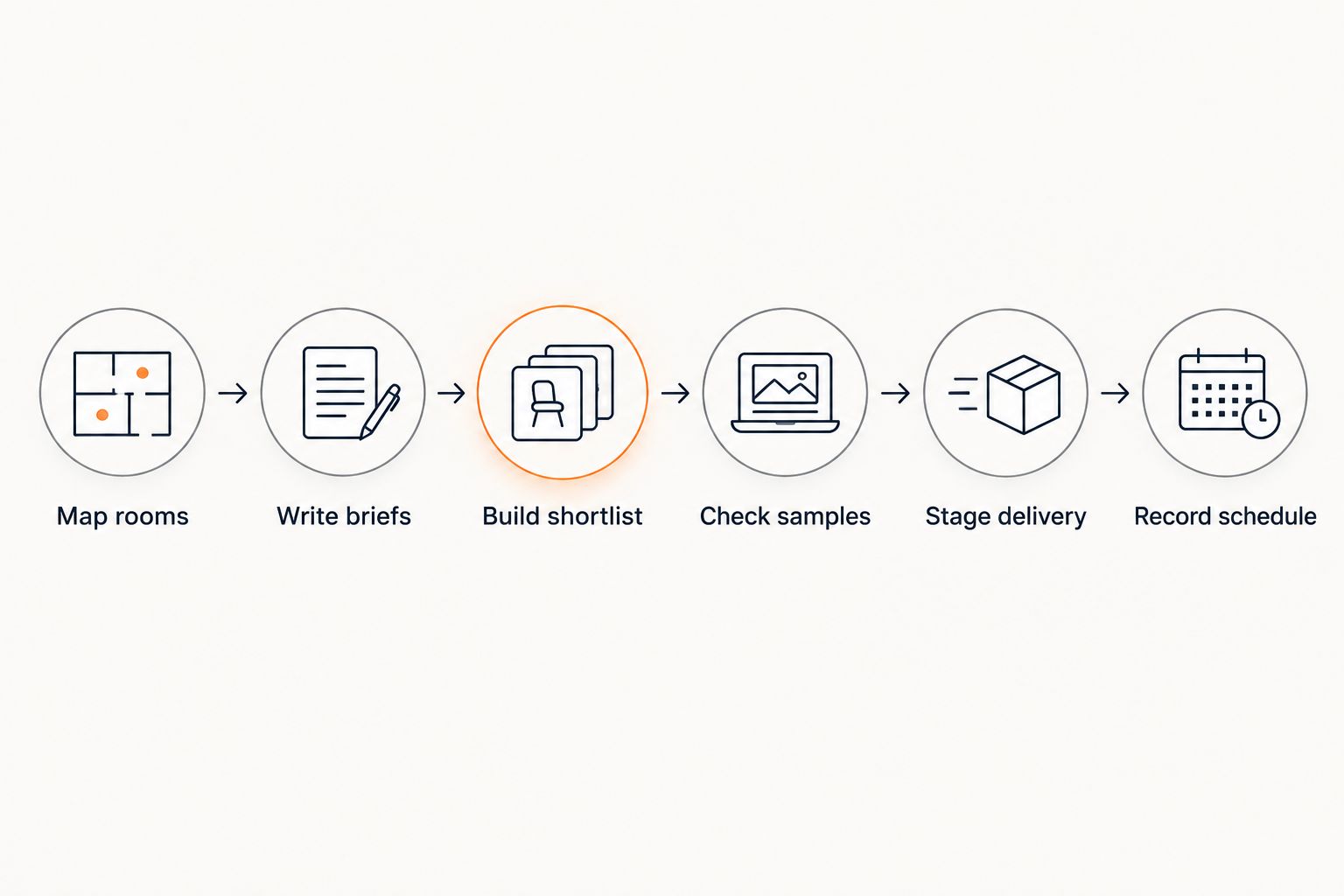
The diagram shows the control point many rushed projects miss: the shortlist is not the order. Sample approval and destination planning sit between those stages.
- Nominate one receiving contact per location
- Share the room schedule before each dispatch
- Pilot the process at one location where practical
- Check delivered quantities against each room line
- Log outstanding items and decisions in one place
Record the final furniture schedule
Close the project with a final schedule that reflects what was received, not only what was ordered. This becomes the reference for moves, room changes and future purchasing. Without it, the next refresh starts with another site audit and another attempt to identify finishes from photographs.
Mobelaris replica furniture considered for the project should be recorded in the same format as every other approved item. Keep retailer names, item titles, published information, destination and approval notes in separate fields so the record remains searchable.
Restrict edits to named schedule owners. A controlled record is more useful than several copies carrying different quantities or item descriptions.
- Replace estimated quantities with received quantities
- Attach sample and delivery photographs to the relevant record
- Preserve the exact retailer and item names
- Note the destination room for every approved line
- Archive superseded versions without deleting the final history
Compare sourcing options for corporate offices
Facilities managers can source replica furniture through one retailer, several specialist retailers, an external procurement adviser or a mixed reuse programme. The right option depends on the number of categories involved, the internal approval process and how much coordination the facilities team can own.
| Option | Best for | Main advantage | Key limitation |
|---|---|---|---|
| One multi-category retailer | Projects seeking one visual direction across seating, tables and lighting | Fewer supplier records and a simpler shortlist | One catalogue might not cover every room requirement |
| Several specialist retailers | Projects with a separate brief for each furniture category | Wider category choice | More samples, deliveries and finish records to coordinate |
| External procurement adviser | Teams that need another party to coordinate the schedule | Central point for supplier communication | Adds another approval layer between facilities and retailers |
| Existing furniture plus selected replica pieces | Phased refurbishments retaining usable items | Reduces the number of new decisions | Matching new finishes to existing furniture takes careful review |
Mobelaris fits the multi-category retailer option because its stated range covers chairs, sofas, tables, storage, lighting and accessories. Its advantage is category breadth for shortlist building. Its limitation is the same as any retailer-led route: the buyer remains responsible for the room schedule, internal approvals and final order checks.
For a 2026 rollout, choose the route before gathering product links. Mixing sourcing models halfway through approval creates duplicate comparisons and weakens control of the final schedule.
Common mistakes corporate facilities managers make
Starting with a design name instead of a room
A design-led search produces attractive options but does not define where they belong. Start with the room function, existing interior and required furniture category, then assess items against that brief.
Using one specification for every office area
Reception, waiting, meeting and private office spaces should not inherit one generic furniture list. Shared colours can connect the rooms, while separate schedules preserve the distinctions between their functions.
Treating the sample as an informal check
A sample review needs a recorded outcome. Without an approval note, photographs and the selected finish, later stakeholders cannot tell whether the sample was accepted or merely received.
Combining all locations into one quantity
A single total hides where each unit belongs. Quantities should be recorded by site and room so the receiving contact can check the delivery without reconstructing the original plan.
Losing the final record after installation
The order confirmation is not the final furniture schedule. Update the record with received quantities, destinations and approved item information, then preserve it for the next move or refresh.
FAQ
What is replica furniture for corporate offices?
Replica furniture for corporate offices is furniture made in the style of recognised mid-century designs and selected for workplace areas such as receptions, meeting rooms and private offices. Facilities managers should control it through room briefs, sample approval and a final furniture schedule.
How should facilities managers choose replica office furniture?
Facilities managers should begin with a room inventory and written brief, then compare retailer-supplied product information against those requirements. The shortlist should identify the destination, selected finish, quantity and approval status for every item.
Should every corporate office use the same furniture?
No, every corporate office does not need identical furniture. A shared palette and related design direction can connect locations while individual room schedules account for different layouts and functions.
When should a sample unit be ordered?
A sample unit should be reviewed before a wider quantity is approved when the procurement process allows it. Record the selected finish, supplied details, photographs and approval decision so the sample becomes a usable project reference.
Is one furniture retailer better than several suppliers?
One retailer is better when simpler coordination and a consistent shortlist matter most, while several suppliers provide more category choice. The trade-off is additional sample, delivery and record management for the facilities team.
What should a corporate furniture schedule include?
A corporate furniture schedule should include the retailer, exact item title, published specifications, selected finish, quantity, destination and approval status. The final version should reflect what was received rather than only what was initially ordered.
One last thing
The most useful document in a 2026 corporate furniture project is not the mood board. It is the final room-by-room schedule connecting every approved item to a destination, quantity and source record. Mobelaris replica furniture and every other shortlisted option should enter that schedule before approval, not after delivery.